Teknik Belgeler
Özellikler
Marka
United AutomationÜrün Tipi
Sürücü Modülü
Montaj Tipi
DIN Rayı
Pim Sayısı
9
Minimum Çalışma Sıcaklığı
0°C
Maksimum Çalışma Sıcaklığı
65°C
Standartlar/Onaylar
European Low Voltage Directive, EN61010-1, EN 50 081 part 2, European EMC Directive, EN61000-6-2
Seri
DFMC36
Otomotiv Standardı
NO
Ürün Ayrıntıları
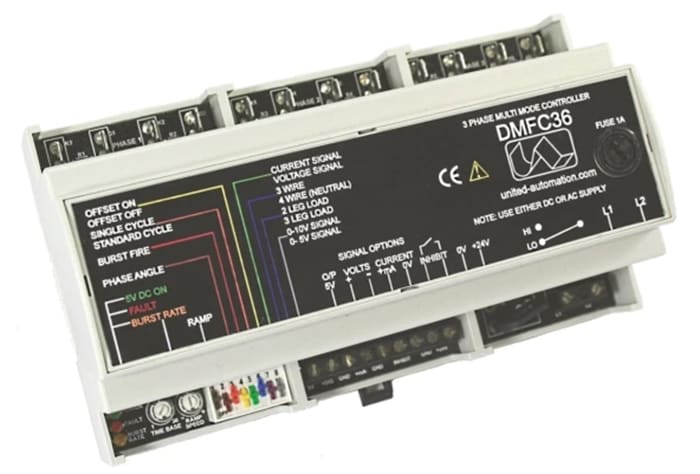
The DMFC-36 module has been designed to offer Phase-Angle or Burst Fire Control in firing a thyristor assembly or complete thyristor controller for driving resistive loads. In Single-Cycle or Dual-Cycle mode, these modules use the fastest burst rates possible, providing very accurate control and minimising Harmonic distortion & Flicker within the system.
The number of complete mains cycles during fixed repeating periods (typically 1 to 10 seconds) is varied, thus altering the duty cycle or on-/off-time ratio. Trigger pulses coincide with the zero-crossing times of the mains supply thus ensuring no RFI is produced when using resistive loads.

Ideate. Create. Collaborate
JOIN FOR FREE
No hidden fees!


Stok bilgileri geçici olarak kullanılamıyor.
Teklif İsteyiniz
1
Teklif İsteyiniz
Stok bilgileri geçici olarak kullanılamıyor.
1
Ideate. Create. Collaborate
JOIN FOR FREE
No hidden fees!
Teknik Belgeler
Özellikler
Marka
United AutomationÜrün Tipi
Sürücü Modülü
Montaj Tipi
DIN Rayı
Pim Sayısı
9
Minimum Çalışma Sıcaklığı
0°C
Maksimum Çalışma Sıcaklığı
65°C
Standartlar/Onaylar
European Low Voltage Directive, EN61010-1, EN 50 081 part 2, European EMC Directive, EN61000-6-2
Seri
DFMC36
Otomotiv Standardı
NO
Ürün Ayrıntıları
The DMFC-36 module has been designed to offer Phase-Angle or Burst Fire Control in firing a thyristor assembly or complete thyristor controller for driving resistive loads. In Single-Cycle or Dual-Cycle mode, these modules use the fastest burst rates possible, providing very accurate control and minimising Harmonic distortion & Flicker within the system.
The number of complete mains cycles during fixed repeating periods (typically 1 to 10 seconds) is varied, thus altering the duty cycle or on-/off-time ratio. Trigger pulses coincide with the zero-crossing times of the mains supply thus ensuring no RFI is produced when using resistive loads.
Ideate. Create. Collaborate
JOIN FOR FREE
No hidden fees!